Wine and Spirits Alchemy Accelerated Maturation
Rural Alchemy-5 Putting It All Together
How our complete accelerated maturation system fits together.
In the first four Rural Alchemy articles, we examined the principal components of our accelerated maturation system. Here, we pull back and look at the complete process: which products need it, how a batch moves through it, what we can control, and how we decide when a wine or spirit is truly finished.
Introduction
Yes, we’re helping to save America’s forests “one barrel at a time,” but that is only part of the reason we have put so much effort into Rural Alchemy. At its heart is a product and operating philosophy: excellence in wine and distilled spirits is not determined by a calendar—or by the container in which a product happens to wait. It is determined by flavor, bouquet, balance, texture, and finish.
Traditional barrel aging works, but it also leaves important variables to the barrel, the warehouse, the weather, and time. By isolating and controlling many of those variables, we can produce a more consistent and exceptional bottled product while using far less wood and keeping far less money tied up in inventory.
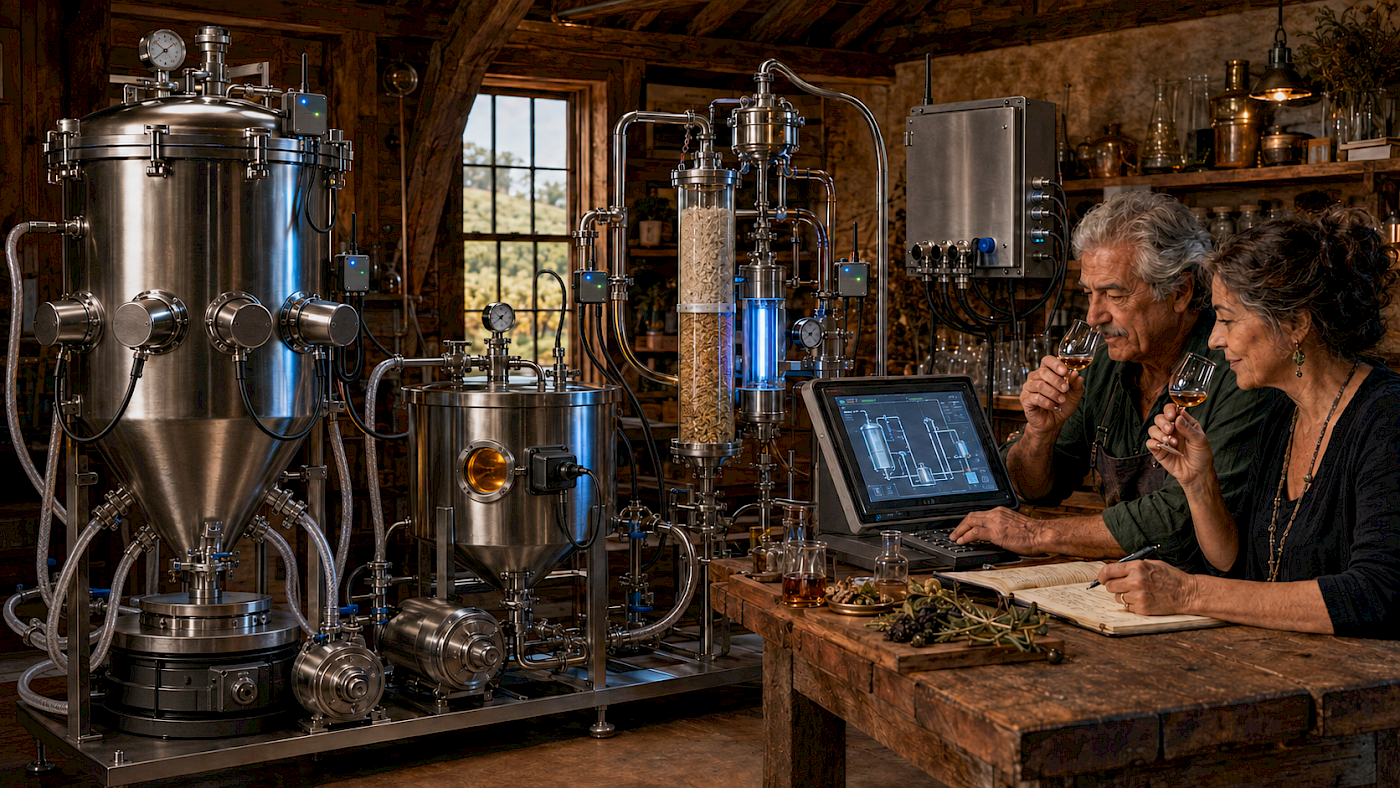
This final article explains how the pieces described throughout the series—carefully selected wood, ultrasonic cavitation, controlled motion, oxygen management, bioactive filtration, perlite, UV-C, and continuous monitoring—work together as one adaptable system.
Not All Our Products Need the Maturator
Our wines are specifically crafted to be enjoyed young. Once fermentation is complete, they remain in stainless steel containers protected by an airlock and a blanket of inert gases—nitrogen, argon, and carbon dioxide—to limit oxidation. After about a month to “relax,” the wines are bottled. Our red wines, Jupiter and Nox, receive toasted oak chips during fermentation and bulk relaxation, giving them the wood character we want without requiring a separate trip through the maturator.
On the distilled-spirits side, our eau-de-vie-style brandies bypass the maturator. Eve and Cherry Bomb are intended to remain crystal clear, fresh, and fruit-forward. After distillation, they are proofed to 40% alcohol by volume with distilled water and bottled without wood maturation.
Doozy, Bloody Butcher, and Close Hauled are different. Their malt, grain, and blackstrap-molasses foundations benefit substantially from the extraction, oxidation, esterification, and smoothing normally associated with years in wood. In our case, they take a carefully programmed tour through the maturator and can be ready for bottling in a matter of days.
From New Spirit to Finished Bottle
Although every recipe is different, a typical batch follows the same general journey. The point is not to force every spirit through an identical schedule. The point is to give us control over each stage and let the character of the spirit determine what happens next.
- Define the destination. Before processing begins, we establish the flavor, bouquet, color, texture, and finish we want from the completed spirit.
- Select the wood. We choose the species, toast or char level, chip size, quantity, and—in some cases—a blend of woods that will contribute the desired compounds without overwhelming the underlying distillate.
- Begin controlled extraction. Ultrasonic transducers create microscopic cavitation bubbles that drive liquid into the wood structure and release desirable flavor and aroma compounds far more quickly than passive soaking.
- Add motion and rest. The wobble platform keeps the spirit moving gently across the wood, recreating some of the effects historically observed in barrels transported by ship. Periods of motion, ultrasound, and rest can be scheduled independently rather than applied continuously.
- Manage filtration. Depending on the recipe, filtration may occur during maturation or after extraction is complete. Our hybrid system combines barley straw, UV-C exposure, and food-grade perlite to remove unwanted compounds and haze while preserving the spirit’s desirable character.
- Measure, taste, and adjust. Instrument readings tell us what is happening inside the system; sensory evaluation tells us whether those changes are producing the spirit we intended. Neither replaces the other.
- Finish and bottle. When the spirit reaches its target profile, we stop the process, complete any final filtration, proof it to bottling strength, allow it to marry and stabilize as needed, and then bottle it.
Decisions, Decisions…
After distillation, we decide exactly how the spirit should be matured before proofing and bottling. Because the process is modular, we can control several factors that contribute to the quality and personality of the finished product.
- What wood and toast or char should we use? We are not attempting to force every product into a narrowly defined traditional style. That gives us room to select the wood treatment that best serves the spirit. We may combine woods for a broader balance of flavors and bouquet, or use several toast and char levels in one batch to control the extraction of tannins, vanillin, oak lactones, caramelized sugars, smoky compounds, and color.
- How much ultrasonic energy should we use? Ultrasonic excitation transfers substantial energy into the distillate and wood chips and also produces heat. We can regulate both intensity and duration, controlling how quickly extraction occurs and changing the energy applied during different stages of maturation. More is not automatically better; the objective is controlled extraction, not maximum extraction.
- How much motion does the batch need? The maturator rests on a wobble platform that reproduces the gentle, irregular movement associated with transportation over water. Each recipe can receive a different “voyage,” with its own pattern of movement and rest.
- When and how should we filter? Filtration can be performed as a batch operation, as an in-line operation while the spirit circulates, or after wood extraction is complete. We can adjust circulation rate, contact time, the amount of perlite and barley straw, and the duration of UV-C exposure to suit the needs of the batch.
- How much oxygen should the spirit encounter? Some oxidation is essential to maturation, but uncontrolled oxidation can flatten aromas and create undesirable flavors. The system allows us to manage air exchange deliberately rather than accepting whatever a barrel and warehouse happen to provide.
The Instruments Watch; We Still Taste
The computer controlling the process continuously monitors distillate temperature, pH, dissolved oxygen, internal circulation, circulation between the maturator and filtration system, and—very importantly—color. Those measurements provide a real-time record of the batch and allow the processing program to make planned adjustments when operating limits or target values are reached.
But Rural Alchemy is not a machine making flavor by spreadsheet. Instruments can measure temperature, oxygen, flow, acidity, and color; they cannot fully measure whether a whiskey has become inviting, whether a rum’s molasses character remains alive, or whether the finish has become warm rather than harsh. Samples are evaluated throughout the process, and the final decision is made by taste and aroma. The data makes the process repeatable. Human judgment makes the product worth repeating.
Every completed batch adds to our operating knowledge. Its process history, laboratory measurements, sensory notes, and final settings become a starting point for the next batch—not an inflexible recipe, but a well-informed map.